One ETF Prospectus Clause That Delayed Every Dividend Payment by Five Days

Imagine waiting five extra days for a dividend you thought was coming tomorrow. That delay isn't a glitch or a bank error. It's written into the fine print of many exchange-traded fund prospectuses, often on page 47 or deeper, in a sentence that reads something like: "Distributions will be paid within five business days after the record date." For investors accustomed to the one-day settlement of individual stock dividends, this gap feels like a hidden tax on time. This article walks through the clause, the players behind it, and the real cash-flow friction it creates.
The Hidden Clock: How One Sentence Rewrites the Payout Timeline
Standard equity dividends in the United States settle on a T+1 schedule. That means if the ex-dividend date is Monday, the cash lands in a brokerage account by Tuesday. For ETFs, the timeline is different. The prospectus clause that extends the payout to "up to five business days after the record date" effectively stretches what could be a two-day process into a full week. The record date is typically one day after the ex-date, so the maximum delay from ex-date to payment can be six calendar days.
Why would a fund include such a clause? The answer lies in the operational complexity of ETFs. Unlike a single stock, an ETF is a basket of securities that may trade across multiple markets and time zones. The fund must collect dividends from each underlying holding, reconcile those cash flows with the shareholder register, and then distribute the net amount. The five-day window gives the fund's administrator and custodian a legal buffer to complete these steps without rushing.
But the buffer is not always used fully. Some large ETFs, such as those tracking the S&P 500, often pay dividends within two or three business days. Smaller or international-focused funds may take the full five days because their underlying securities settle on slower schedules. The clause is a maximum, not a promise of speed, and the variation can be confusing for investors trying to plan their cash needs.
The language itself is standardised across many fund families. It appears in the "Dividends and Distributions" section of the prospectus, often alongside a note that the fund reserves the right to pay distributions more frequently or at different times. For the typical retail investor who skips the prospectus, the first sign of a delay is when the expected deposit does not show up on the brokerage statement.
Meet the Clause: 'Payment Date' vs. 'Ex-Date' Mismatch
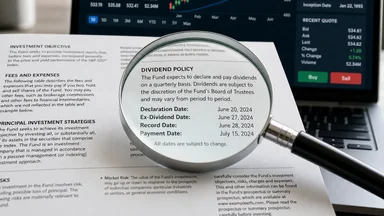
To understand the delay, it helps to distinguish three key dates in any dividend payment. The ex-dividend date is the first day a buyer of the shares is not entitled to the upcoming dividend. The record date is the date on which the fund looks at its shareholder list to determine who gets paid. The payment date is when the cash actually arrives in the investor's account. For individual stocks, the payment date is usually one or two business days after the record date. For ETFs, the prospectus clause allows a longer gap.
The mismatch arises because the fund's distribution process is not instantaneous. After the record date, the fund's transfer agent must compile the list of all shareholders, including those who hold through intermediaries like brokerages. This list can be large and complex, especially for ETFs that trade on multiple exchanges or have authorized participants creating and redeeming shares daily. The five-day window accounts for this reconciliation.
Brokerages themselves add another layer. Even if the fund distributes the cash on day three, the brokerage may not credit the investor until it receives the distribution notice and the funds. Some brokerages post dividends as soon as they receive the information, but others wait until the cash actually settles. This can add another day or two for investors at smaller firms.
The clause is not unique to ETFs. Mutual funds also have similar language, but their redemption and dividend cycles are different. For ETFs, the delay is more noticeable because investors expect the same speed as stock dividends. The mismatch between ex-date and payment date can also affect tax reporting, as the dividend is taxable in the year the ex-date falls, even if the cash arrives in the following year.
The Custodian's Pause: Why the Fund Doesn't Release Cash Immediately
The custodian bank plays a central role in the dividend delay. When an ETF receives dividends from its underlying holdings, those dividends accumulate in a custodial account. The custodian must reconcile the total dividend pool against the shareholder positions as of the record date. This reconciliation includes adjustments for foreign withholding taxes on international dividends, which can vary by country and by the fund's tax status.
Fractional shares add another complication. ETFs often have small residual cash amounts from share creation and redemption activity. The custodian must calculate the per-share dividend to several decimal places and then apply it to each shareholder's position. For funds with millions of shares outstanding, this calculation is straightforward in theory but requires careful rounding and verification in practice.
Some funds apply a "haircut" to the dividend pool as a safety buffer. This is a small percentage, often less than 0.1%, that the fund retains to cover potential overpayments or adjustments. The haircut is later reconciled and distributed in the next payout, but it can delay the final amount reaching investors. The practice is disclosed in the prospectus's fee section, but many investors overlook it.
Automated systems handle most of this work, but human sign-off is still required before the custodian releases the funds. The five-day window allows time for exceptions, such as a dividend from a holding that is restated or a foreign tax treaty that needs manual verification. In practice, the custodian aims to release the funds as soon as possible, but the clause gives them permission to wait.
Retail Investors Feel the Lag: Real-World Cash Flow Friction
For retail investors, the delay can cause real friction. Those who use margin accounts may incur interest charges while waiting for the dividend to credit. If a dividend of $500 is delayed by five days, and the margin interest rate is 8%, the cost is roughly $0.55. That is small, but it compounds across multiple holdings and throughout the year. For investors who reinvest dividends automatically, the delay means missing a few days of market exposure, which can affect the compounding effect over decades.
Retirees who rely on monthly dividend income are particularly sensitive to timing. A five-day delay can push a payment into the next month, creating a cash shortfall if the retiree has bills due. Some retirees choose to hold individual stocks for this reason, accepting higher volatility for more predictable cash flow. The ETF industry has responded with some products that pay dividends on a fixed schedule, but the prospectus clause remains the default.
Comparison across fund families reveals variation. Vanguard's S&P 500 ETF (VOO) typically pays dividends within two business days of the record date, while some smaller international ETFs from other providers take the full five days. The difference is not always disclosed upfront, so investors must check the prospectus or ask their broker. As of late 2024, some estimates put the average delay for U.S. equity ETFs at roughly three days, but the range is wide.
The friction is not limited to individuals. Financial advisors who manage model portfolios must account for the timing when rebalancing or withdrawing funds. A dividend that arrives later than expected can throw off a cash-flow projection. Some advisors have built buffer assumptions into their planning tools, but the lack of standardisation across ETFs makes it hard to predict.
How This Clause Compares to Other Fine-Print Traps
This dividend delay clause belongs to a broader family of fine-print mechanisms that shift timing in ways that benefit the institution. A similar dynamic appears in checking account disclosures, where a checking account fine print clause can reorder deposits and delay availability. In both cases, the institution gains a float advantage: the cash sits in its account earning interest while the customer waits.
The annuity world has its own version, where a fee that compounds against a benefit base can erode value over time. And for tax deductions, a 1996 IRS letter ruling shows how a single interpretation can rewrite the rules for an entire class of taxpayers. The common thread is that a small, seemingly technical provision can have outsized effects on cash flow and returns.
ETF investors are not helpless. Reading the prospectus's dividend section before buying can reveal the maximum delay. Some investors choose funds that have a track record of faster payments, though past speed is not guaranteed. The Securities and Exchange Commission requires clear disclosure of the payment timeline, but the information is often buried in dense legal language.
Critics of the clause argue that modern technology should make same-day dividend payments feasible. The Depository Trust & Clearing Corporation (DTCC) processes stock dividends in near real-time, and ETFs could theoretically use the same system. However, the fund industry has been slow to change, citing the complexity of international holdings and the need for reconciliation. The five-day window remains the industry standard, and few funds have moved to shorten it.
What Can an Investor Do About the Delay?
For those who want to avoid the delay, the simplest option is to hold individual dividend-paying stocks instead of ETFs. This eliminates the fund-level reconciliation step, though it introduces single-stock risk. Another option is to use ETFs that pay dividends on a fixed schedule, such as monthly or quarterly, and that have a history of paying on time. Some bond ETFs and preferred stock ETFs have more predictable payment dates.
Investors can also ask their broker to notify them of expected dividend dates and actual credit dates. Some brokerages offer alerts that can help with cash-flow planning. For those using automatic reinvestment, the delay is usually minor, but it can be worth monitoring if the amounts are large. A $10,000 dividend delayed by five days at a 5% annual return costs roughly $6.85 in lost opportunity, which is small but not negligible.
Tax-aware investors should note that the dividend is taxable in the year of the ex-date, regardless of when the cash arrives. This means a dividend declared in late December but paid in early January is still taxable in the earlier year. The five-day delay can push payment into the next year, but the tax liability follows the ex-date. This can create a cash-flow mismatch if the investor needs the cash to pay the tax bill.
Trade-Offs: Speed vs. Accuracy in Distribution
Proponents of the five-day window argue that it reduces the risk of payout errors. If a fund rushed to distribute dividends within one day, mistakes in shareholder records or foreign tax calculations could lead to overpayments or underpayments. Correcting those errors later is costly and time-consuming. The buffer allows custodians to double-check figures, especially for funds with complex holdings like emerging market bonds or commodities.
But the trade-off is real: the delay imposes a small but systematic cost on investors. For a large ETF with $10 billion in assets and a dividend yield of 2%, the total annual dividend pool is about $200 million. If the average delay is three days, the fund's custodian earns interest on that float. At a 4% interest rate, that float is worth roughly $65,000 per year. That money stays with the custodian or the fund, not the investor. While the amount is tiny per investor, the aggregate is significant.
Some fund providers have experimented with accelerated payment schedules. For example, a few fixed-income ETFs now promise payment within one business day of the record date. These funds use simpler portfolios—mostly U.S. Treasuries—where reconciliation is straightforward. The trend suggests that competition could eventually erode the five-day norm, but change is slow.
Another trade-off involves international ETFs. Funds that hold stocks in markets like India or Brazil must deal with local settlement cycles that can take several days. The five-day window gives them time to convert foreign currency and remit funds back to the U.S. Without that buffer, investors might face even longer delays or higher currency conversion costs. In this case, the clause serves a practical purpose, even if it feels like a burden.
Ultimately, the clause is a reminder that fine print matters. The five-day delay is not a conspiracy; it is a practical accommodation for operational complexity. But as with many financial products, the burden of that complexity falls disproportionately on retail investors who lack the time or expertise to parse every line. A more transparent system would disclose not just the maximum delay but the typical delay, allowing investors to plan accordingly.
The industry is not likely to change overnight. Competition could push some fund providers to shorten the window as a differentiator, but so far, the five-day clause remains widespread. Until then, investors who understand the clause can at least adjust their expectations and avoid the surprise of a missing deposit.
This article is for informational purposes only and does not constitute personalised investment advice. Consult a qualified financial professional for advice tailored to your situation.