One Bank Contract Clause That Waives Your Right to Dispute a Statement After Thirty Days

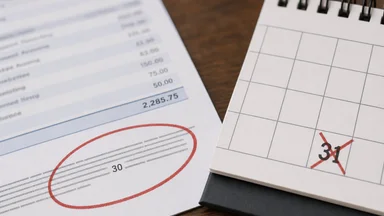
When you open a checking or savings account, you sign a deposit account agreement that runs dozens of pages. Buried in that fine print is a clause that can strip away your right to challenge a mistake on your statement after just 30 days. It applies to unauthorized debits, double charges, and even bank errors. Most consumers never notice it until they try to dispute a charge on day 31 and are told the bank no longer owes them a dime.
The 30-Day Trap Hidden in Plain Language
The clause typically reads something like: "You must notify us of any error or unauthorized transaction within 30 days after the statement is sent. If you fail to do so, you waive all claims against us." It is not buried in a footnote; it is usually in a section titled "Your Responsibility to Review Statements" or "Dispute Resolution." But because the language is dry and legalistic, most people skip it.
This 30-day window applies to a broad range of errors. It covers unauthorized charges that appear on your statement, amounts that were debited twice, checks that were altered before cashing, and even fees that were assessed incorrectly. The clause does not require the bank to prove you received the statement or that you actually read it. The mere act of mailing or posting it online starts the clock.
Banks rely on this clause to deny claims routinely. According to a 2025 Federal Reserve payments study, consumer confusion about dispute timelines is widespread. The study found that roughly one in five consumers who attempted to dispute an error were told their claim was untimely under the account contract, even when the error was clearly the bank's fault.
The clause is not limited to small community banks. Major national banks, credit unions, and online-only banks all include it. It is a standard term in virtually every deposit account agreement in the United States, though the exact number of days can vary. Some contracts give 30 days; others give 45 or 60. But 30 remains the most common.
How the Clause Works in Practice
The clock starts ticking on the date the statement is issued, not the date the transaction occurred. If a fraudulent debit hits your account on the first of the month, but the statement is not generated until the 15th, you have 30 days from the 15th to catch it. That sounds generous until you consider mail delays. If you receive paper statements by mail, the statement may take a week to arrive. By then, a week of your 30-day window is already gone.
Online statements present a different problem. Many consumers opt for electronic statements and never log in to view them. A 2024 survey by the Consumer Financial Protection Bureau estimated that roughly 40 percent of consumers do not open their electronic statements within 30 days of receipt. For those consumers, the dispute window expires before they even see the statement.
Banks treat late disputes as final. Once the 30 days pass, the bank has no obligation to investigate or reimburse. Even if you later discover clear evidence that the charge was unauthorized — a signature that does not match yours, a receipt showing a different amount — the bank will point to the clause and refuse. The burden of proof shifts entirely to you after the deadline.
There is no grace period for vacations, illness, or other life events. If you are hospitalized for two weeks and miss the window, the bank is not required to accommodate you. The clause is absolute. Some banks have internal policies that allow exceptions, but they are not required by the contract, and consumers have no way to enforce them.
Regulatory Gaps That Allow This Practice
Federal law provides some protections for electronic errors. Regulation E, which implements the Electronic Fund Transfer Act, gives consumers 60 days to report unauthorized electronic transfers from the date the statement is sent. If you report within that window, the bank must investigate and, in most cases, refund your money. But Regulation E only covers electronic transactions — ATM withdrawals, debit card purchases, and online bill payments.
Paper checks and other non-electronic transactions fall under the Uniform Commercial Code (UCC) Article 4. The UCC sets a one-year limit for customers to report unauthorized signatures or alterations on checks. That is a far longer window than 30 days. But banks are allowed to shorten that period by contract, and they do. The 30-day clause effectively overrides the UCC's one-year limit for check errors.
The Federal Reserve's 2025 payments study highlighted the confusion this creates. Consumers who are familiar with Regulation E's 60-day window for debit card disputes assume the same protection applies to checks. It does not. The study recommended clearer disclosures but stopped short of calling for a regulatory mandate to standardize dispute timelines.
State laws vary widely. Some states, like California, have enacted laws that require a minimum 60-day window for all deposit account disputes. But most states defer to the contract terms. If you live in a state without such a law, your only protection is what the bank chooses to offer. As of mid-2026, no federal mandate requires a minimum 60-day window for all types of errors.
Why Banks Insist on 30 Days
Banks defend the 30-day clause as a matter of operational necessity. After 30 days, they argue, it becomes harder to verify transactions. Surveillance footage may be erased, merchant records may be purged, and the customer's own memory may fade. A short window encourages consumers to review their statements promptly and report errors while evidence is still fresh.
There is also a cost motive. Processing disputes requires staff time, system checks, and sometimes legal review. By limiting the window, banks reduce the volume of disputes they must handle. Industry data suggests that roughly 70 percent of all disputes are filed within the first 30 days. Extending the window to 60 days would increase the workload by an estimated 15 to 20 percent, according to a 2023 study by the American Bankers Association.
The clause also shifts the burden of proof to the customer after the deadline. Before 30 days, the bank must investigate and refund if the error is confirmed. After 30 days, the customer must prove the bank was at fault — a much higher bar. Few consumers have the resources to gather evidence and pursue a claim in court, so most give up.
Large payment processors, such as Visa and Mastercard, have their own dispute rules that often give merchants and card issuers 120 days to respond. But those rules apply to card transactions, not to the underlying deposit account. The bank's 30-day clause for checking and savings accounts operates independently of the card network rules, creating a gap that consumers rarely understand.
Real-World Consequences for Account Holders
Consider a common scenario: An unauthorized debit of $500 appears on your statement. You do not notice it until day 31 because you were traveling. The bank denies your dispute, citing the 30-day clause. You are out $500. If that debit caused your account to overdraw, you may also owe overdraft fees of $30 to $40 per transaction. Some banks charge additional fees for each day the account remains negative.
The consequences can ripple beyond the immediate loss. If the unauthorized debit drains your account, any automatic payments you set up — rent, utilities, loan payments — may bounce. Each returned payment can trigger a separate fee from the merchant, plus a late fee. Your credit score may suffer if the missed payment is reported to the credit bureaus.
Small claims court is an option, but it is rarely used. The filing fee and time commitment often exceed the amount in dispute. A 2024 study by the National Consumer Law Center found that fewer than 2 percent of consumers who were denied a dispute due to a time limit pursued legal action. The vast majority simply absorbed the loss.
Even when the error is clearly the bank's fault — for example, a teller error or a system glitch — the 30-day clause can still be enforced. In a 2023 case in Ohio, a consumer's check was cashed for $10,000 instead of $1,000 due to a bank employee's mistake. The consumer did not notice for 45 days. The bank refused to correct the error, and the court upheld the 30-day clause as valid. The consumer was left with a $9,000 loss.
What to Look For in Your Own Contract
To find the clause in your own deposit account agreement, look for a section titled "Time Limit for Reporting Errors" or "Your Responsibility to Review Statements." The exact wording varies, but it will mention a specific number of days — often 30, sometimes 45 or 60. If you cannot find it, call your bank and ask. They are required to provide a copy of the agreement upon request.
Pay close attention to whether the clock starts on the date the statement is sent or the date you receive it. Most contracts use the date sent. Also check whether online statements are treated the same as paper statements. Some banks send a notification email when an online statement is available, and the clock starts from that email, even if you never open it.
Look for exceptions. Some contracts carve out fraud or recurring charges. For example, a clause might say that the 30-day limit does not apply to unauthorized transactions if the bank was grossly negligent. But those exceptions are rare and narrowly defined. Do not assume your contract has them.
Compare your bank's clause with Regulation E's 60-day limit for electronic errors. If your bank's clause is shorter than 60 days, it may still be enforceable for paper checks and other non-electronic transactions. For electronic errors, the federal limit applies regardless of what the contract says. But if you wait beyond 60 days, even Regulation E will not protect you.
How to Protect Yourself Beyond 30 Days
The simplest protection is to review every statement within a week of receiving it. Set a recurring calendar reminder or enable transaction alerts that notify you of every debit above a threshold you choose — say, $50 or $100. Most banks offer customizable alerts in their mobile app or online portal. If you see a charge you do not recognize, file a dispute immediately. You do not need all the details to start the process; you can provide additional documentation later.
If you miss the 30-day window, file a dispute anyway. Some banks will make an exception if you have a good explanation, such as a hospital stay or extended travel. Ask to speak with a supervisor. While the bank is not required to honor a late dispute, it may do so as a courtesy. Get written confirmation that your dispute was received, even if it is denied. That documentation may help if you decide to escalate to a regulator.
Consider switching to a bank that offers a longer dispute window. Some credit unions and community banks offer 60 or even 90 days. Online-only banks often have more consumer-friendly terms because they compete on customer experience. Before opening a new account, ask to see the deposit agreement and check the dispute clause. It is a simple question that can save you hundreds of dollars.
Finally, if you believe the bank has acted unfairly, you can file a complaint with the Consumer Financial Protection Bureau or your state's attorney general. While the CFPB cannot overturn a contract clause, it can investigate patterns of abuse and may pressure the bank to make a goodwill payment. For disputes involving electronic errors, the CFPB can also enforce Regulation E directly.
For more on how contract terms can create unexpected financial traps, see our related articles on annuity withdrawal fees and insurance definitions of heart attack.
This article is for informational purposes only and does not constitute legal, financial, or professional advice. Consult a qualified professional for advice tailored to your situation.