One OAuth Implicit Flow Decision Locked Three Teams Into a Single Identity Provider

In 2019, a mid-size SaaS company with three product teams made a seemingly innocuous decision: use OAuth 2.0 implicit flow for their new single-page application. The frontend team wanted simplicity. The backend team wanted to avoid managing refresh tokens. The security team approved the standard OAuth flow. Seven years later, that choice has locked all three teams into a single identity provider, with migration costs estimated between $200,000 and $400,000. The implicit flow, deprecated by the OAuth working group in 2019, remains a trap that companies fall into every day.
The OAuth Implicit Flow That Tied Three Teams to One Vendor
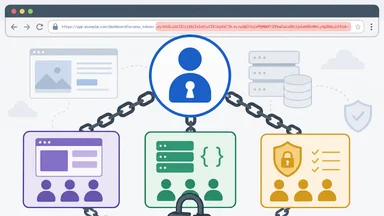
The implicit flow was designed for browser-based applications that could not keep a client secret. The access token is returned directly in the URL fragment after user authentication. No refresh token is issued. No client authentication is performed. The token lives in the browser's address bar, exposed to history, bookmarks, and referrer headers.
For the frontend team, this meant they could get a token with a single redirect. No backend proxy, no token exchange endpoint. But the token expired after an hour, and without a refresh token, the only way to get a new one was to redirect the user again. The user was thrown back to the identity provider's login page every hour, often losing their place in the application.
The backend team initially appreciated the simplicity. They didn't need to implement a token exchange endpoint or manage refresh token storage. But they quickly discovered they had no way to revoke sessions. The identity provider's session cookie controlled the user's authentication state, not anything the backend could enforce. When a user logged out of the identity provider, the frontend had no way to know until the next token refresh attempt.
The security team inherited a system where the access token was exposed in the browser URL. Any browser extension, any malicious script running on the page could capture it. The token's scope was broad—it needed to cover multiple APIs—so compromise of one frontend meant compromise of all backend services. The implicit flow had no binding between the token and the client, so token replay was trivial.
By 2023, the company had three teams building features that all depended on the same identity provider's session management. The frontend team couldn't implement single sign-on across subdomains without the provider's proprietary SDK. The backend team couldn't issue their own tokens for service-to-service calls. The security team couldn't enforce token rotation because the implicit flow didn't support it. The identity provider had become a single point of failure, and switching would require rearchitecting the entire auth flow.
Why Implicit Flow Was Never Meant for Production
The OAuth 2.0 Authorization Framework, RFC 6749, published in 2012, included the implicit flow as a concession to browser-based apps that couldn't keep a secret. But the RFC itself warned: "The implicit grant type does not include client authentication, and relies on the presence of the resource owner and the registration of the redirection URI." It was intended for situations where the client could not be trusted with credentials—not as a production authentication pattern.
The implicit flow's fundamental flaw is the access token in the URL fragment. While the fragment is not sent to the server, it is visible in the browser's address bar. Any script running on the page can access it via window.location.hash. Browser history stores the URL with the fragment. The referrer header, when set, can leak the token to third-party sites. These are not theoretical risks; they are documented attack vectors that have been exploited in real-world breaches.
Proof Key for Code Exchange (PKCE), defined in RFC 7636 in 2015, was the community's answer. PKCE allows a public client—one without a client secret—to use the authorization code flow securely. The client generates a cryptographically random code verifier and its transformed code challenge. The authorization server binds the authorization code to the challenge, so even if the code is intercepted, it cannot be exchanged for a token without the verifier.
Despite PKCE being a standard for nearly a decade, many teams still default to implicit flow out of convenience. The OAuth working group deprecated implicit flow in 2019, recommending authorization code with PKCE for all public clients. Yet a 2024 survey by a major identity provider found that roughly 30% of new single-page applications still use implicit flow. The inertia of copy-pasted code and outdated tutorials keeps the pattern alive.
The cost of that inertia is not just security risk. It's operational complexity. Implicit flow forces teams to rely on the identity provider's session management, which varies wildly between vendors. Some providers tie token lifetime to the user's login session; others have fixed token expiration independent of session state. The frontend team ends up implementing complex refresh logic using hidden iframes or postMessage—workarounds that PKCE eliminates.
The Vendor Lock-In That Follows a Default Choice
When a team chooses implicit flow, they implicitly accept the identity provider's session management policies. The provider decides how long the access token lives, whether refresh tokens are available (they are not in implicit flow), and how session revocation works. The team cannot change these policies without switching providers, and switching providers means rearchitecting the auth flow from scratch.
Vendor lock-in in identity is insidious because it appears to be free. The identity provider offers a generous free tier, easy SDKs, and quick setup. But once the application's auth flow is wired to that provider's implicit flow implementation, the switching cost accumulates silently. Every custom claim, every proprietary session extension, every SDK-specific hook becomes a migration liability.
The contract renegotiation costs are often hidden. When the provider raises prices—as several major identity providers did in 2024 and 2025—the team cannot easily walk away. The engineering cost of migrating auth flows for a production application with thousands of users is substantial. Some estimates put this near $200,000 to $400,000 for a mid-size application, accounting for development, testing, user migration, and rollback planning.
Microsoft's Patch Tuesday in July 2026 fixed a record 570 vulnerabilities, many in identity and authentication components. While patching is good, it highlights the risk of deep integration with a single vendor. When a critical vulnerability is disclosed in your identity provider's SDK, you must patch immediately—but if your auth flow is tightly coupled to that SDK, you may have no alternative. The provider becomes a single point of failure, not just for authentication but for your entire security posture.
Companies that use implicit flow also lose the ability to implement multi-provider authentication. If you want to allow users to log in with Google or Apple or a corporate IdP, implicit flow forces you to use the primary provider's federation capabilities. You cannot easily support multiple direct identity providers because the implicit flow's token endpoint is tied to one issuer. This limits user choice and creates a single point of vendor dependency.
Authorization Code with PKCE: The Escape Hatch
Authorization code with PKCE solves the problems that implicit flow created. The client never sees the access token directly; it receives an authorization code that must be exchanged for a token via a back-channel request. The code verifier ensures that even if the authorization code is intercepted, it cannot be used without the verifier. The token never appears in the browser URL.
PKCE does not require a client secret, making it suitable for public clients like single-page applications and native mobile apps. The flow works with any OAuth 2.0-compliant authorization server. Apple, Google, and Microsoft all recommend PKCE for their own platforms. Apple's App Store review guidelines require PKCE for apps using OAuth. Google's Identity Platform documentation explicitly states that implicit flow is deprecated in favor of authorization code with PKCE.
Refresh tokens are a key advantage of authorization code with PKCE. The authorization server can issue a refresh token along with the access token. The client can use the refresh token to obtain new access tokens without user interaction. Refresh tokens can be rotated—each refresh request returns a new refresh token and invalidates the old one. This limits the window of compromise if a refresh token is stolen. Implicit flow has no refresh token, so every token refresh requires a full redirect.
Multiple identity providers can be supported with the same authorization code with PKCE pattern. The client initiates the authorization request to the chosen provider, receives the authorization code, and exchanges it via its own backend. The backend can route token exchange to the appropriate provider based on the user's selection. This pattern enables multi-provider authentication without duplicating the auth flow logic.
The migration from implicit flow to authorization code with PKCE is not trivial, but it is well-understood. The OAuth working group published a migration guide in 2020. The key steps are: add a backend token exchange endpoint, update the frontend to use the authorization code flow, configure the authorization server to issue refresh tokens, and implement token rotation. The cost is significant, but it is a one-time investment that eliminates ongoing vendor lock-in and security risk.
The Business Case for Auth Independence
Vendor lock-in in authentication has direct business consequences. When a company is acquired or spun off, the identity provider contract may not transfer cleanly. The acquiring company may have its own identity provider, forcing a migration. The cost of that migration is often underestimated in M&A due diligence. A 2023 study by a consulting firm found that identity migration costs were a factor in roughly 15% of post-acquisition integration delays.
Multi-cloud strategies demand portable authentication. Companies that run workloads across AWS, Azure, and Google Cloud cannot afford to be locked into one cloud provider's identity service. Each cloud provider has its own OAuth implementation, with subtle differences in token formats, scope handling, and revocation APIs. Authorization code with PKCE abstracts over these differences, allowing the application to use any provider that implements the standard.
Alibaba's deal with Apple to bring Qwen AI models to Apple Intelligence in China, announced in July 2026, illustrates the global fragmentation of identity and AI services. As companies expand into new markets, they must comply with local data sovereignty and authentication requirements. A portable auth layer allows them to adapt to regional identity providers without rewriting the entire application. Open standards like OAuth 2.1, which consolidates best practices including PKCE and token rotation, reduce switching costs.
Security audit costs rise when the auth flow uses proprietary extensions. External auditors must understand the identity provider's specific behavior, which may not be documented in public standards. If the provider changes its token format or session policy, the audit scope expands. Companies that use standard OAuth with PKCE can point auditors to the RFCs and avoid the cost of proprietary analysis.
The business case for auth independence is not just about avoiding lock-in; it is about enabling future flexibility. Startups that expect to be acquired should design auth to be portable. Enterprises that run multiple business units should standardize on a single auth pattern that works across providers. The cost of designing for portability upfront is negligible compared to the cost of migrating a production system.
Three Rules to Avoid the Same Trap
First, never use implicit flow for new applications. The OAuth working group deprecated it in 2019, and all major identity providers recommend authorization code with PKCE. If you are starting a new project, use PKCE from day one. The upfront cost is minimal—a few extra lines of code for the code verifier and challenge—and the long-term benefit is enormous.
Second, implement token rotation and refresh token rotation. Token rotation ensures that each refresh token can be used only once, limiting the damage if a token is stolen. Refresh token rotation, where the refresh token itself is rotated on each use, provides an additional layer of security. The OAuth 2.0 for Browser-Based Applications specification (RFC 8252) recommends this pattern.
Third, abstract the identity provider behind a thin adapter layer. The adapter should expose a standard interface for login, logout, token refresh, and user info. The implementation behind the adapter can use any provider's SDK, but the application code never calls the SDK directly. This abstraction makes it possible to switch providers by implementing a new adapter, without touching the rest of the application. Test the migration path early by setting up a secondary provider in a staging environment and running a trial migration.
Finally, audit token lifetime and revocation policies annually. Token lifetimes that are too short frustrate users; lifetimes that are too long increase risk. Revocation policies should allow immediate invalidation of all tokens for a user when their account is compromised or terminated. These policies should be documented and reviewed as part of the annual security audit. The identity provider's default settings are rarely optimal for your specific threat model.
The team that chose implicit flow in 2019 is now planning a migration that will take six months and cost hundreds of thousands of dollars. They are not alone. Hundreds of companies face the same decision every year. The choice is not between implicit flow and authorization code with PKCE; it is between paying a small cost now or a large cost later. The OAuth community has provided the escape hatch. The question is whether teams will take it before the lock-in becomes too expensive to break.