One 2018 Treasury Rule Lets a Gig Platform Write Off Expenses You Already Reported

If you drive for a rideshare or delivery platform, you know the basic setup: you are an independent contractor, you receive a Form 1099-NEC, and you deduct expenses like mileage, gas, and insurance on Schedule C. What may come as a surprise is that the platform itself is also deducting many of those same expenses — not on your return, but on its own. A single Treasury regulation finalized in 2018 makes this possible, and the IRS has done little to stop it.
The regulation, Treasury Regulation 1.199A-3, governs the qualified business income (QBI) deduction created by the Tax Cuts and Jobs Act of 2017. The QBI deduction allows owners of pass-through entities — sole proprietorships, partnerships, S corporations — to deduct up to 20% of their qualified business income. For a gig driver, that means if you report $50,000 in net profit on Schedule C, you can deduct $10,000 from your taxable income. But the regulation also allows the platform itself to aggregate the expenses of its drivers into its own QBI calculation, effectively claiming a deduction for costs the drivers already deducted. The result is a double dip that Congress never intended.
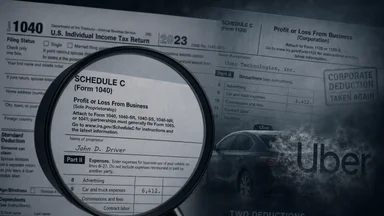
Consider a concrete example. Driver Alex drives for Uber in 2023 and earns $30,000 in gross receipts. Alex deducts $10,000 in vehicle expenses (mileage, gas, insurance) on Schedule C, leaving $20,000 in net profit. Alex then claims a QBI deduction of $4,000 (20% of $20,000). Separately, Uber includes in its own QBI calculation the $30,000 it paid to Alex as a cost, plus an allocable share of overhead that includes the same categories Alex deducted. Uber's QBI deduction reduces its corporate tax liability by millions of dollars. The same $10,000 in expenses is deducted twice — once by Alex on Schedule C, and once by Uber in its QBI computation.
This article walks through the rule, how the double deduction works, why it survived IRS scrutiny, what the platform gains, and what you as a driver should do to protect your own deduction. It is a contrarian take on a widely-repeated piece of advice: that the QBI deduction is a straightforward benefit for small business owners. The reality is more complicated, and the fine print of Reg. 1.199A-3 reveals a loophole that primarily benefits the platform, not the driver.
The Rule You Have Probably Never Heard Of
Treasury Regulation 1.199A-3 was finalized in January 2019, retroactive to tax years beginning in 2018. It fleshed out the QBI deduction under Section 199A, which was added by the Tax Cuts and Jobs Act. The regulation defines what counts as a qualified trade or business and, critically, how to compute QBI for businesses that involve independent contractors.
Under the regulation, a gig platform qualifies as a specified service trade or business (SSTB) if its principal asset is the reputation or skill of its workers. The IRS and Treasury have taken the position that rideshare and delivery platforms are not SSTBs — an interpretation that many tax scholars dispute. But even if they were, the QBI deduction phases out only at higher income levels, so most platforms still benefit.
The key provision is in Reg. 1.199A-3(b)(1)(vi), which states that a taxpayer may include in its QBI the allocable share of income and deductions from a partnership or S corporation. The platform structures itself as a corporation that contracts with drivers, but the regulation's aggregation rules allow it to treat driver expenses as its own for purposes of computing QBI. The IRS issued Notice 2019-07 to clarify that the aggregation rules apply only to businesses under common control, but the notice did not address the double-deduction issue directly.
As a result, the platform can deduct the same categories of expenses that drivers deduct: vehicle costs, phone bills, insurance, even tolls and parking. The platform does not file a Schedule C for each driver, but it includes those expenses in its own QBI computation on Form 8995 or 8995-A. The driver, meanwhile, deducts those same expenses on Schedule C. Two taxpayers claim a deduction for the same economic outlay.
How the Double Deduction Works
The mechanics are straightforward. The QBI deduction is 20% of qualified business income. For a driver, QBI is net profit from Schedule C — gross receipts minus expenses. For the platform, QBI includes its net income from operations, which it calculates by deducting all costs, including payments to drivers and the expenses it attributes to those drivers.
The double deduction arises because the platform treats driver expenses as its own for QBI purposes, even though the driver has already deducted them. The IRS has not issued guidance prohibiting this practice. In fact, the preamble to the final regulations acknowledges that aggregation may result in "duplicative" deductions but states that this is consistent with the statute's purpose of reducing the tax burden on pass-through businesses.
The result is a tax expenditure that Congress likely did not anticipate. The Joint Committee on Taxation estimated that the QBI deduction would cost roughly $400 billion over ten years when enacted. That estimate assumed the deduction would benefit small business owners, not large platforms. But because the aggregation rules allow platforms to include driver expenses in their QBI, a significant portion of that tax expenditure flows to corporate bottom lines rather than to individual drivers.
To put it in perspective, consider a scenario where a platform like Lyft has 1 million drivers, each earning an average net profit of $15,000 after expenses. If Lyft aggregates those expenses, its QBI could be inflated by billions, leading to a deduction worth hundreds of millions. That deduction directly reduces Lyft's tax liability, while drivers each claim their own 20% deduction on their individual returns. The same dollars are deducted twice.
Why This Survived IRS Scrutiny
One might ask why the IRS has not stepped in to close the loophole. The answer lies in a combination of administrative complexity and political inertia. The IRS does not cross-check Schedule C deductions against platform returns. There is no matching program for QBI deductions analogous to the underreporter program for wages and tips.
Revenue Ruling 2019-11 addressed a narrow question about whether a driver's QBI is reduced by the platform's expenses, but it sidestepped the aggregation issue entirely. The ruling held that a driver cannot deduct expenses paid by the platform, but it did not address whether the platform can deduct expenses the driver already deducted. The IRS has not issued any further guidance on this point.
Another reason is structural: the platform treats drivers as independent contractors, not employees. If drivers were employees, the platform would deduct their wages as a business expense, and the employees would not deduct those same costs. But because drivers are independent contractors, both parties claim deductions. The IRS has historically been reluctant to reclassify workers as employees, and the QBI aggregation rules were not designed with this dynamic in mind.
Congressional intent also plays a role. The QBI deduction was sold as relief for small businesses, but the statutory language does not exclude large pass-through entities. Platforms are structured as C corporations in some cases and as pass-throughs in others, but the aggregation rules apply regardless. Until Congress amends Section 199A, the IRS is limited in what it can do through guidance alone.
Some tax experts have argued that the IRS could issue regulations clarifying that driver expenses cannot be aggregated for QBI purposes. Professor Heather Field of UC Hastings College of the Law has noted that the aggregation rules were intended for related parties under common control, not for arm's-length contracts with thousands of independent contractors. But no such guidance has been proposed.
What the Platform Gains
The financial benefit to platforms is substantial. Uber disclosed in its 2020 10-K that it claimed roughly $1.5 billion in QBI deduction benefits. Lyft reported a similar figure in its SEC filings for the same year. These deductions reduced their effective tax rates to below 10% in some years, far below the statutory corporate rate of 21%.
The deduction does not trickle down to drivers. The platform's tax savings benefit shareholders and executives, not the workers who generated the income. Drivers see no increase in their own QBI deduction because the platform's deduction is computed separately. In fact, the platform's deduction may indirectly reduce driver compensation over time, because the platform has less incentive to pay higher rates when it is already benefiting from a tax break.
Some tax policy analysts have called this a "tax expenditure shift" — the benefit that Congress intended for small business owners is being captured by large corporations. The Tax Policy Center estimated in 2021 that roughly 40% of QBI deduction benefits flow to taxpayers with incomes above $1 million, many of whom are owners of large pass-through entities rather than individual freelancers.
For the platform, the deduction is essentially free money. It does not have to change its operations or reduce fares to claim it. The only cost is the accounting work to aggregate driver expenses into its QBI computation. Given the scale of the benefit, that cost is trivial.
To illustrate, suppose a platform spends $10 million on accounting to aggregate driver expenses, but gains $500 million in tax savings. That is a 50-to-1 return. No wonder the practice is widespread.
What You as a Driver Should Do
If you drive for a platform, the most important step is to keep your own mileage logs separate from any records the platform provides. The platform's year-end tax summary often includes an estimate of your deductible expenses, but that estimate may be based on different methods than the IRS standard mileage rate. Do not rely on it.
Claim your own standard mileage rate deduction on Schedule C. The IRS allows 65.5 cents per mile in 2023 for business use of a vehicle. That deduction is yours to take, regardless of what the platform reports. Do not reduce your QBI by the platform's reported expenses. Your QBI is your net profit, not the platform's calculation.
When you file Form 8995 or 8995-A to compute your QBI deduction, enter only your own net profit from Schedule C. Do not include any amounts the platform may have reported as "expenses" on your 1099-NEC. The platform's expenses are not your expenses for QBI purposes, even if the platform aggregates them.
Finally, consult a CPA who is familiar with the Section 199A aggregation rules. This is a niche area of tax law, and many general practitioners are not aware of the double-deduction issue. A CPA can help you ensure you are claiming the full deduction you are entitled to without inadvertently reducing it by relying on platform-provided data.
The Bigger Picture: A Tax Code Written for 1980
The QBI deduction was drafted before the gig economy existed. The Tax Cuts and Jobs Act was passed in December 2017, when Uber was six years old and Lyft was five. The gig economy has grown exponentially since then, but the tax code has not kept pace.
No statutory fix has been proposed in the six years since the regulation was finalized. A 2025 Treasury report flagged the double-deduction issue as a potential area for reform, but it noted that any change would require legislation or significant regulatory overhaul. The report also acknowledged that reform would be complex, because it would require defining which expenses are properly attributable to drivers versus platforms.
Until Congress acts, the double deduction remains legal. Drivers are effectively funding a corporate tax break every time they deduct mileage on Schedule C while the platform claims the same deduction on its own return. The IRS has the authority to issue guidance that would limit the aggregation of driver expenses, but it has chosen not to do so.
This is not a partisan issue. Both Republican and Democratic administrations have declined to address the loophole. The reason is likely that closing it would require reclassifying some drivers as employees or imposing new reporting requirements, both of which are politically unpopular. Until the cost of inaction becomes visible to voters, the loophole will persist.
Three Numbers to Watch on Your Return
When you prepare your tax return, pay attention to three specific numbers. First, Line 13 of Form 8995-A (or the equivalent line on Form 8995) shows the aggregated QBI amount. This should match your net profit from Schedule C, not the platform's gross payments to you.
Second, Line 17 of Form 8995-A is for qualified REIT dividends, which are irrelevant for most drivers. If you see an amount there, make sure it is accurate and not a carryover from the platform's tax summary.
Third, Schedule C Line 9 is where you report total expenses. Compare this to Box 1 of your 1099-NEC. If your expenses are significantly lower than the platform's reported income, your net profit will be higher, and your QBI deduction will be larger. But if the platform's tax summary shows expenses that exceed your own records, that is a red flag: the platform may be overstating deductions in its own return, which could eventually trigger an audit of its QBI computation.
If the platform reports more income on your 1099-NEC than your net profit on Schedule C, investigate why. The difference may be legitimate — the platform includes gross payments, while your net profit subtracts expenses — but it could also indicate that the platform is claiming deductions for expenses you already deducted. In that case, you should consult a tax professional.
Looking Ahead: The Push for Reform
Several tax policy organizations have called for Congress to amend Section 199A to prevent the double deduction. The Tax Foundation has proposed limiting the aggregation rules to businesses under common control, which would exclude platforms from claiming driver expenses. The American Bar Association's Section of Taxation has submitted comments to the Treasury recommending that the IRS issue guidance clarifying that driver expenses are not includible in a platform's QBI.
Legislatively, the issue has bipartisan potential. In 2023, Senator Ron Wyden (D-OR) introduced the "Gig Worker Tax Fairness Act," which would require platforms to report driver expenses separately and would prohibit aggregation for QBI purposes. The bill has not advanced, but it signals growing awareness. On the Republican side, Representative Kevin Brady (R-TX) has expressed interest in simplifying the QBI deduction but has not specifically addressed the double-deduction issue.
Drivers can advocate for reform by contacting their representatives and sharing their experiences. The more visible the problem becomes, the harder it will be for Congress to ignore. In the meantime, understanding the rules and protecting your own deduction is the best defense.
This article is for informational purposes only. Consult a qualified tax professional regarding your specific situation.